Logistics starts before the parcel is shipped
The digital market is already large. According to DataReportal’s “Digital 2026: Romania”, 17.7 million people in Romania were using the internet at the end of 2025 — 94% of the population. For Polish e-commerce that means a broad pool of potential customers, but also a market that knows online shopping standards increasingly well.
Entering the Romanian market is often planned in this order: translate the store, launch campaigns, pick a payment provider, and only then arrange delivery. The sequence looks logical, but it is at that last stage that the customer makes one of the more important decisions: whether the fulfilment terms feel convenient and credible.
Delivery is visible in the cart. Its price, lead time and available collection methods can close a sale or stop it. What happens afterwards matters just as much: whether tracking works from the moment of dispatch, whether the recipient gets a clear notification, whether the courier can reach them, and how the store handles a return.
On a foreign market the margin for error is smaller. A customer who does not know the brand scrutinises every trust signal. Cash on delivery, a local delivery method and a simple returns process confirm that the store understands how the market works, rather than having merely translated its Polish site.
Home or parcel locker? Romanian shoppers want the choice
The “Radiografia eCommerce în România” study by easySales and MerchantPro maps the preferences well. Courier delivery to home was chosen by 50.29% of respondents. Parcel lockers came second at 35.08%. Delivery to an office reached 10.47%, while showroom or post office collection was already marginal.
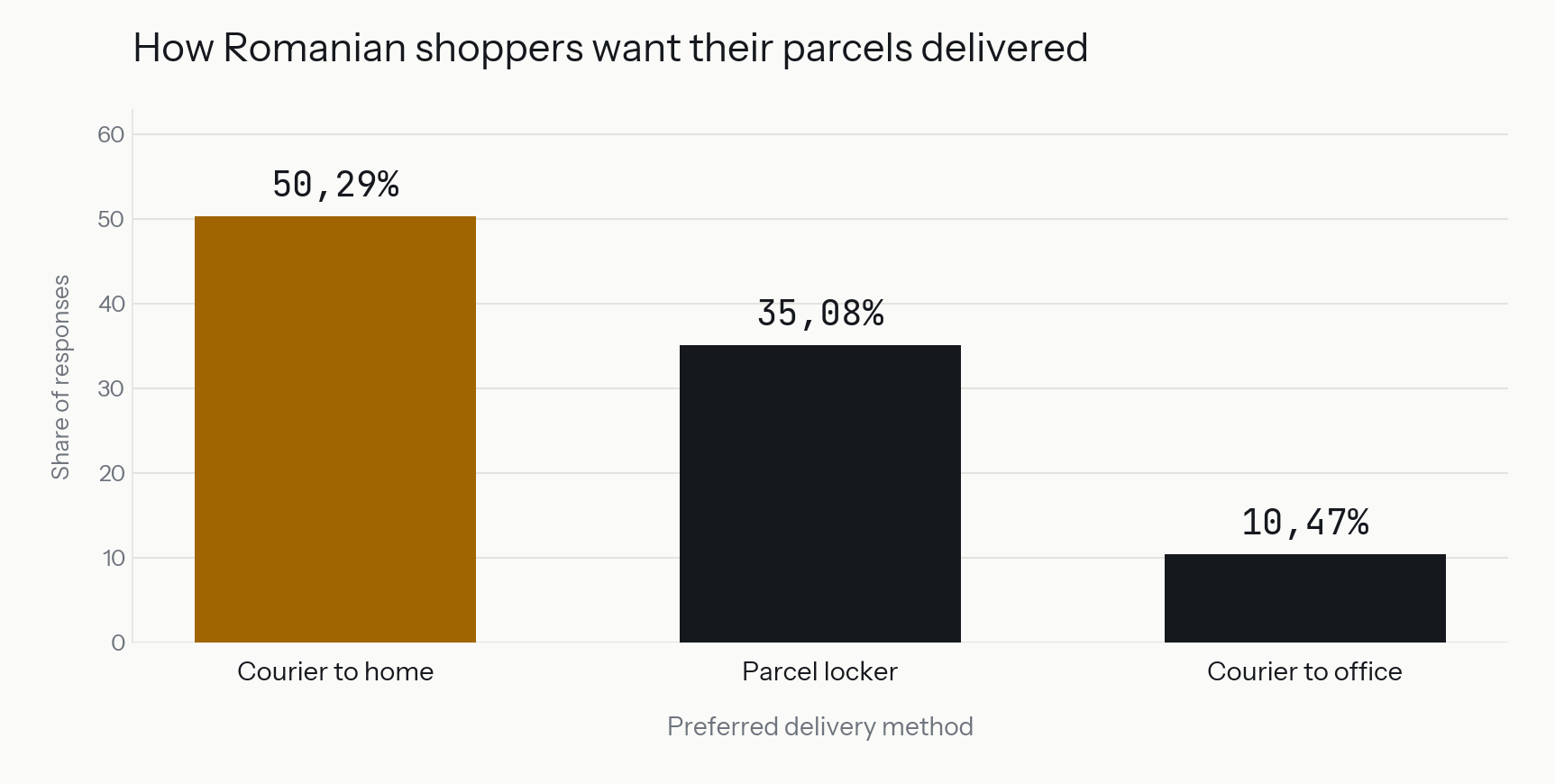
The conclusion should not be “pick home delivery”. Romania today is a market with two strong last-mile models. The classic courier still leads, but lockers have become a full part of the shopping standard. Their advantage is simple: the customer does not have to wait at an address and can collect the parcel whenever it suits them.
For a foreign store this means one delivery method may not be enough. Offer a choice between delivery to an address and a parcel locker, and for lockers provide a map or a clear list of points. Typing in a locker location by hand quickly leads to mistakes and to customer service tickets.
How fast should the parcel arrive?
Pressure for same-day delivery in Romania is lower than one might expect. In the same study, 57.46% of respondents considered 3 working days the expected delivery time. Next-day delivery was expected by 26.84%, while only 2.23% pointed to same-day delivery.
That does not mean the deadline can be treated loosely. For 34.69% of participants, lead time was the part of an order that caused the most dissatisfaction. What counts is therefore not only speed, but predictability and consistency with the promise made in the store.
An honestly communicated 48 or 72 hours is safer than an “express delivery” promise that cannot be kept at peak season.
If delivery is going to take three days, the customer should know before paying. If the date changes, they need a current status.
COD still builds trust
Cash on delivery is not a transitional arrangement in Romania that can be skipped at the start of selling. Card payments are gaining ground, but a share of consumers still want to pay only once the parcel actually reaches them. In the easySales and MerchantPro study, 65.21% of respondents named the card as their preferred payment method, while 28.78% chose cash on delivery.
It shows even more clearly in real orders handled by Crosswin. Our data shows that over 60% of parcels delivered to homes in Romania are paid on delivery. COD also appears on deliveries to parcel lockers, where its share exceeds 20%.
Cash on delivery matters most when a customer is buying from a foreign store for the first time. Paying on arrival reduces perceived risk — the customer does not have to hand money upfront to a brand they do not yet know. Dropping COD can therefore make it harder to win exactly the consumers a store is courting at the start of its expansion.
A well-designed COD process should cover not only collecting the money through a local courier, but also clear reporting, order identification and regular payouts to the seller. Working with an operator that settles COD to a Polish bank account makes the method available without opening an account in a Romanian bank.
A Romanian address needs local specifics
One of the less visible but very practical parts of logistics is the address form. Copying Polish fields one to one does not always work. In Romania correct addressing rests on the locality and the county — the județ. In smaller places the commune — comună — can matter too.
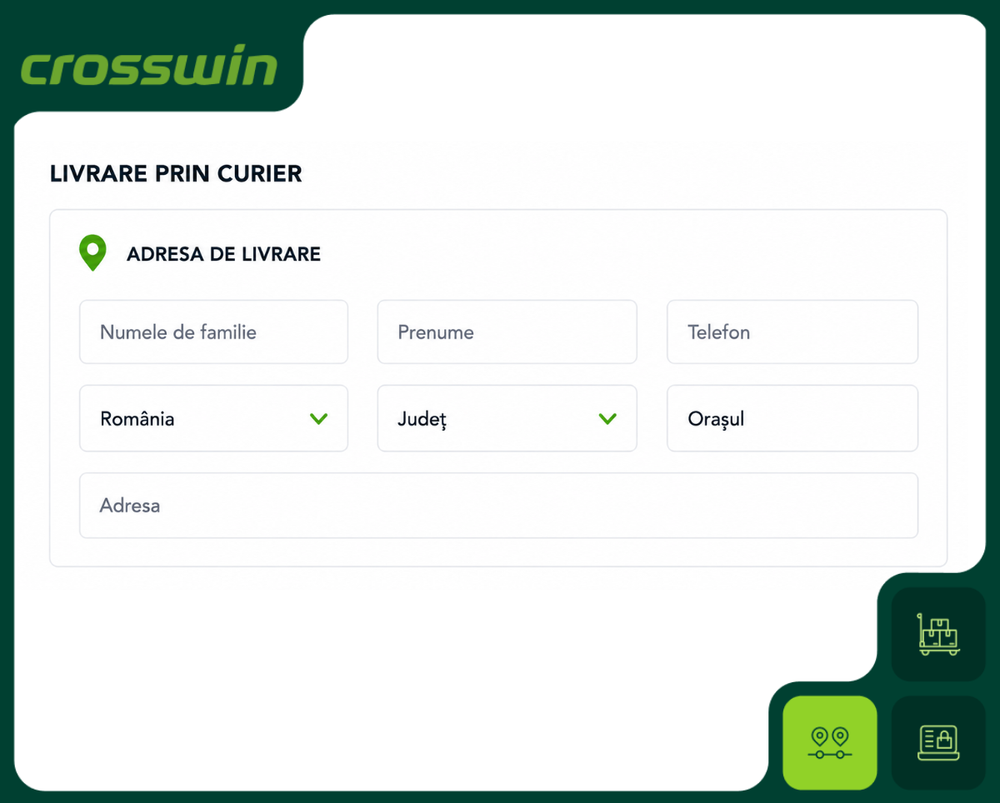
Use dependent dropdowns, data validation and a mandatory phone number field. The phone number matters beyond notifications. It makes it easier for the courier to reach the recipient, particularly outside large cities or when the location needs clarifying.
The postcode should not be the only address validation mechanism. Most Romanian customers do not use it day to day, so strictly requiring six digits can lead to random entries or an abandoned checkout. The safest approach is to base the form on a local database of localities and counties.
Tracking is part of customer service
Once the parcel is dispatched, the customer wants to know what is happening to it. At that point it makes no difference how many operators are involved in the leg between Poland and Romania. From the buyer’s perspective it is one order and one delivery process.
The tracking number should be active from the moment the label is generated, and statuses must update automatically. Messages in Romanian are worth arranging too — an email or SMS should clearly state whether the parcel has been accepted, handed over for delivery or placed in a locker. Missing information quickly shifts the cost of logistics to the customer service team, which starts answering “where is my order?”.
Automation matters on the store side as well. Integration with the sales system or an integration platform reduces manual data re-entry, label errors and delayed status updates. At higher order volumes this stops being a convenience and becomes a condition for scaling.
A return should not start with an international shipment
Customers assess the returns process before they buy, especially in categories such as fashion, footwear, home goods and electronics. If the terms require them to arrange and pay for a shipment to Poland themselves, the perceived risk of buying from a foreign seller rises sharply.
The easySales and MerchantPro study shows that returns policy was the main source of dissatisfaction for 23.74% of respondents. Almost half — 48.74% — expected to be able to send an order back within 30 days, and 32.17% pointed to 14 days. Expectations cover the money too: 40.99% of respondents wanted a refund within five working days, and 32.36% within one working day.
From the store’s perspective, a local return address in Romania is a good solution. The customer sends the product back as a domestic shipment, the operator receives and consolidates the returns, and then forwards them in bulk to Poland. This model lowers the cost per return, simplifies communication and allows faster confirmation of receipt.
What to check before choosing a logistics operator
The lowest parcel price rarely reflects the full cost of serving a market. Before signing a contract, walk through the whole process — from creating a label to settling COD and getting a return back to the warehouse. The points that matter most are:
- real delivery time counted from handover of the parcel;
- availability of home delivery and parcel lockers;
- COD handling, plus settlement frequency and currency;
- tracking that works across the whole process, including after handover to a local partner;
- integrations with the store system, ERP, marketplace or integrator;
- a local return address and how parcels are consolidated;
- rules for undelivered, damaged and oversized shipments.
Logistics should grow with sales
At the start of an expansion a store may ship a dozen or so parcels a week. If campaigns and the assortment work, volume can rise quickly. At that point manual label generation, separate COD reports and an unstructured returns process start to block growth.
It is worth choosing a solution that works both at small scale and at hundreds of orders a day. That does not have to mean a local warehouse from day one. In many cases an effective model can rest on regular departures from Poland, local delivery in Romania and consolidated return logistics.
Companies planning to sell on this market can see how parcel shipping to Romania with Crosswin works in practice — home and locker delivery, COD handling, tracking and local returns.
From the Marketplace365 editors: on a foreign market, logistics and customer service are one process. Every stale status and every unclear return rule comes back to the inbox as “where is my parcel?”. If you are planning to sell in CEE and want someone answering those messages in the local language, take a look at Marketplace365.
Summary
Effective e-commerce logistics to Romania is not just about moving a parcel across the border. It should mirror how people buy locally: combine courier delivery with lockers, allow cash on delivery, handle Romanian addresses correctly and provide an easy local return.
Consistency across the whole process matters most. The lead time shown in the cart has to match real delivery, tracking should work end to end, and return rules must not surprise the customer after purchase. When those pieces are planned well, logistics stops being the back office of sales. It becomes one of the reasons a Romanian customer picks the store again.
FAQ — e-commerce logistics to Romania
How long does delivery from Poland to Romania take?
Romanian customers most often accept delivery within 3 working days, though the exact time depends on the operator and the recipient’s location. With Crosswin, standard delivery from the Crosswin sorting facility to Romania takes around 2 working days.
Is it worth offering cash on delivery in Romania?
Yes. COD is still an important payment method, particularly for customers buying from a foreign store for the first time. Crosswin data shows that over 60% of parcels delivered to homes in Romania are paid on delivery. The seller can have the funds settled to a Polish bank account, without opening an account in a Romanian bank.
Do Romanian customers use parcel lockers?
Yes. According to the easySales and MerchantPro study, 35.08% of respondents preferred locker delivery, against 50.29% for courier delivery to home. A store should therefore offer both collection methods and let customers pick a locker from a map or an up-to-date list of points.
How should returns from Romania to Poland be organised?
The most convenient solution is to give customers a local return address in Romania. Returned parcels can be received locally, consolidated and then transported in bulk to the seller’s warehouse in Poland. The customer does not have to arrange a costly international shipment themselves.
Sources
- DataReportal, “Digital 2026: Romania”: datareportal.com
- easySales and MerchantPro, “Radiografia eCommerce în România”: easy-sales.com
- Crosswin Courier & More operational data on the share of COD in parcels delivered in Romania.

Monika Kosmowska specialises in cross-border e-commerce, marketplaces and logistics for online stores selling abroad. At Crosswin Courier & More she supports Polish companies expanding into Central and Eastern Europe and the Balkans, in particular Romania, Czechia, Slovakia, Hungary, Bulgaria, Croatia, Slovenia and Greece. Her writing covers e-commerce trends, delivery models, payments, COD, returns and the practical side of international selling.